
If someone told me a 2,000-subscriber crafts newsletter would earn its first paid-recommendation dollar before a 10,000-subscriber high-paying newsletter did, I’d have said they were wrong. List size matters. Niche matters. Time live matters. Bigger should win, almost always.
It didn’t.
Masha is a former Chief Marketing Officer in a group of wellness companies, former owner of a boutique Ads Agency, and currently a blogger and blogging VA. She works in digital marketing since 2016.
And the reasons why turned out to be more useful than any generic “how to monetize your email list” post I’ve read in the last year.
This is a live test of Kit’s Paid Recommendations feature — powered by SparkLoop — running on two accounts simultaneously, with very different subscriber counts, niches, and acquisition pipelines. I’ll walk you through the setup gotchas the help docs gloss over, the actual numbers I’m earning from both, and the one variable that turned out to matter more than list size.
I am tessting paid recommendations in two accounts with Kit connected to Sparkloop. One account is small and in a very specific niche, one is in a more high-performing, top-earning niches.
Affiliate disclosure: This post contains affiliate links for both Kit and SparkLoop. If you sign up through one of my links, I may earn a small commission at no extra cost to you. Everything below is from my real experience running Paid Recommendations on two live accounts. I’d write the same review either way.
Why I’m Writing This
I’m testing Paid Recommendations on two Kit accounts at the same time, and they could not be more different:
- Account #1: A small newsletter of mine in a very specific crafts niche. Under 2,000 subscribers.
- Account #2: A client’s newsletter with 10,000+ subscribers, in one of the higher-earning niches.
I went into this expecting the bigger account to obviously make more money, faster. The reality has been more interesting. Surprisingly, my small list earned its first dollar before the big one did. I’ll show you the numbers below.
First, let’s zoom out for a second.
How can you monetize emails?
- Leading traffic back to your site, where you have ads (Ezoic, Mediavine, Raptive). Email clicks have quite good RPMs on Mediavine.
- Kit Ads. There are two types: Programmatic Ads (applications closed), Performance Ads (open beta). Kit’s cut will be 23.5%. You can read about my experiment with Kit Ads here.
- Tips. Simple tip jar.
- Products. The minimal price for your product can’t be lower than 5 USD, and, of course, you will pay Kit a commission (23.5%) plus any transaction fees
- Paid Recommendations (through Spark Loop, where you can join with ANY email provider, not just Kit). I use that on my tiny email list, and it collects a couple of dollars here and there, which isn’t bad.
- Kit affiliate. They have very good commissions, but not good with attributing yours. So you really need to follow up and make sure you get paid for all referrals.
Now let’s get into Paid Recommendations specifically.
How Do Paid Recommendations Work?
When someone subscribes to your email list or requests a freebie through your Kit form or landing page, they see a window suggesting other newsletters they might like.
Some of those are Free Recommendations — you and another creator agreeing to swap audiences with no money changing hands.
Others are Paid Recommendations: another creator pays you for every confirmed subscriber you send their way.
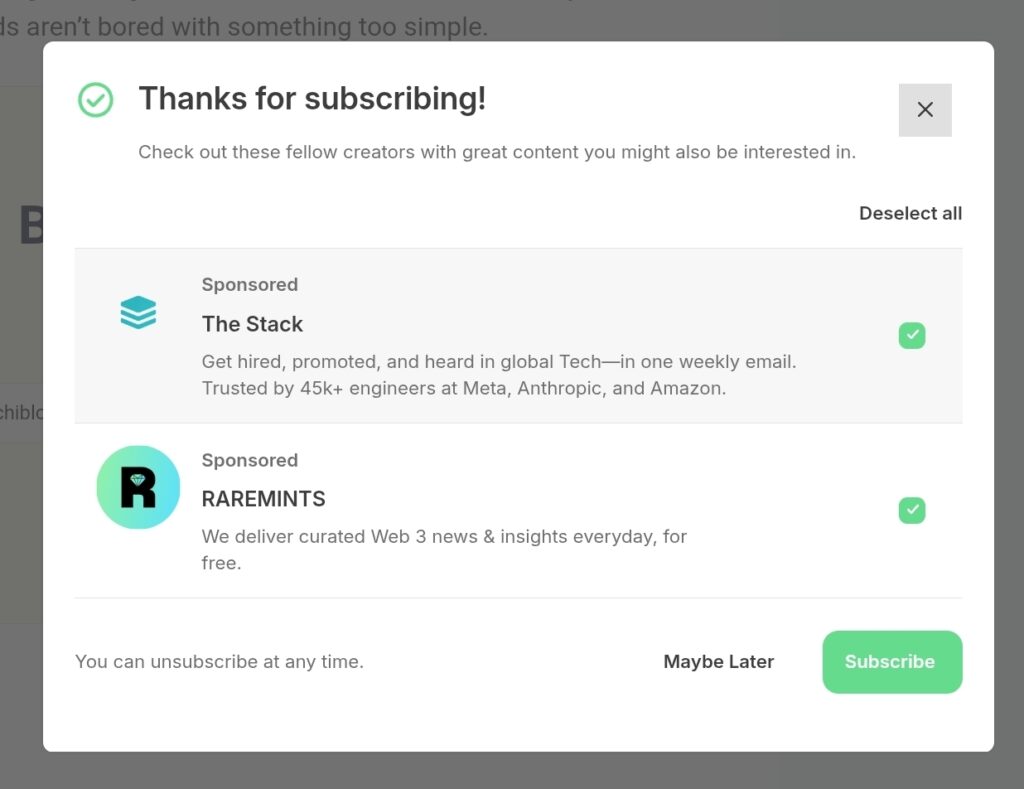
A Paid Recommendation looks identical to a Free one in the subscriber’s view, with one tell: it carries a “Sponsored” tag. The infrastructure under the hood is SparkLoop, an ESP-agnostic platform Kit integrates with.
“ESP-agnostic” means the platform doesn’t care which one you use. SparkLoop works whether your newsletter lives on Kit, Beehiiv, Mailchimp, a custom setup, or anything else. You can plug it in and start running paid recommendations either way.
The going rate? SparkLoop says creators in their Partner Network typically earn $2–$7 per confirmed referral, depending on the publication paying. Kit’s own help center describes the rate as $1 to $4+. Both ranges are accurate from what I’ve seen, with most of my paid recs landing somewhere between $2 and $4.
But that’s gross. Kit takes a 20% service fee plus a 3.5% transaction fee on each successful referral, for a combined cut of 23.5%. So if a sponsor pays $4 per confirmed subscriber, your net is roughly $3.06.
Setting Up Paid Recommendations
Here’s the actual setup, in order:
- Join Kit’s Creator Network. Free Recommendations don’t require SparkLoop, but Paid ones do. You will need to upgrade to a Paid plan, here is a link to a free trial.
- Connect SparkLoop. In Kit, go to Earn → Paid Recommendations → Set up paid recommendations. Either create a new SparkLoop account or link an existing one via API key.
- Connect Stripe. SparkLoop pays out through Stripe. You can create a free Stripe account during the flow if you don’t already have one.
- Wait for approval. SparkLoop typically approves accounts within 24 hours, excluding weekends.
- Pick your recommendations. Once approved, browse the Discover tab and start recommending. Some are pre-approved instantly; others require a manual application where you write a short note about why your audience is a good fit.
- Configure your slots. Kit lets you have up to five recommendation slots, and you choose what fills each: Personal, Paid, Pinned, or Smart. If none of your slots are set to display Paid Recommendations, your paid recs won’t appear at all, even if they’re “active.”
One important gotcha: if you connected an existing SparkLoop account during setup rather than creating a new one through Kit, you’ll also need to add Paid Recommendations to Upscribe and activate Upscribe inside SparkLoop. You don’t have to embed the Upscribe widget on your website, but you do need to switch it on.
If you have any issues, reach out to both supports. My small account had troubles with displaying the recommendations and it took about a month to fix it.
A Word About Auto Pilot
Both Kit and SparkLoop have an Auto Pilot feature. They sound similar, but they live in two different dashboards.
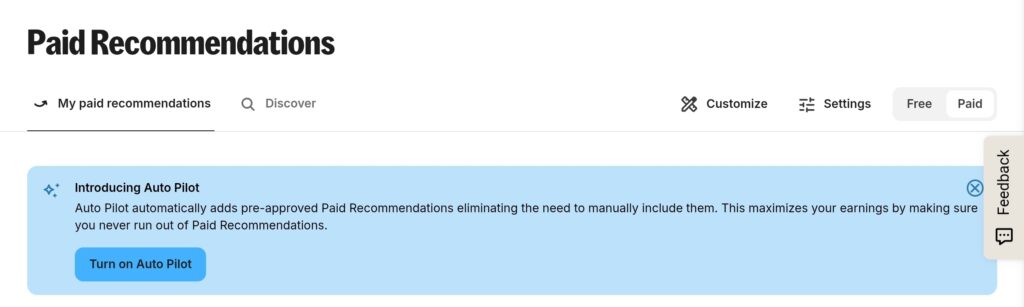
- Kit’s Auto Pilot automatically adds Paid Recommendations you’re pre-approved for, so you keep earning even when individual sponsors run out of budget.
- SparkLoop’s autopilot does the same thing on the Upscribe widget side, rotating in best-fit publications using their SRO (smart recommendations optimization) algorithm.
Fair warning: if you’re very protective of your audience and what recommendations they see, turn OFF the autopilot in BOTH Kit and SparkLoop.
For most creators with a busy schedule, Auto Pilot is genuinely the right call.
SparkLoop reports that creators using autopilot tend to earn significantly more than those who manually customize their widget.
But “earn more” isn’t the only thing that matters if audience trust is your priority.
On both accounts I keep autopilot off because the audience is broader and a bad-fit recommendation has more downside. Make sure to turn it off within kit AND SparkLoop
Why Kit’s Stats and SparkLoop’s Stats Don’t Match
This one tripped me up early on. I’d log into Kit, see a number. Log into SparkLoop, see a different number for the same period. Refresh, and they’d shift again.
A few reasons this happens:
- Different scopes. SparkLoop tracks all referrals across every surface it powers — the Upscribe widget, the Recommendations Hub, Partner Links, in-email recommendations. Kit’s dashboard largely shows what flows through the Kit Creator Network specifically.
- Timing lag. Stats sync between the platforms, but not instantly. A referral can show up in one before the other.
- Status changes. Each referral starts as pending, then either confirms or gets rejected (the subscriber unsubscribed quickly, the email bounced, the address looked low-quality, etc.). Both platforms show those status updates, but on slightly different schedules.
The takeaway: don’t panic about the numbers not matching to the dollar. Pick one source as your “official” view (I use Kit, since that’s where the payouts ultimately flow) and use the other as a sanity check.
I rely on Sparkloop more as it breaks down which paid subscribers were rejected or pending approval, which makes earnings more transparent.
The Caveat With Imported Subscribers
This is specifically a thing I noticed on the accounts when you have third-party email capture forms like Grow or ones designed for you.
A big chunk of those subscribers gets loaded manually from CSV uploads. Those subscribers never see a native Kit form, which means they never see the Recommendations window after sign-up, which means they don’t generate any paid referrals at the moment of subscribing.
If a meaningful slice of your subscriber acquisition happens outside Kit’s own forms, your Upscribe widget is doing nothing for that segment. You’d have to use in-email recommendations to monetize them at all.
This is one of the under-discussed reasons a “smaller list” can outperform a “bigger list” on Paid Recommendations: the small list might be funneling 100% of new subs through native Kit forms, while the big list has 60% of new subs coming in through other doors entirely.
My Income Report (This Section Will Be Updated)
The Small List — Crafts Niche, Under 2,000 Subscribers
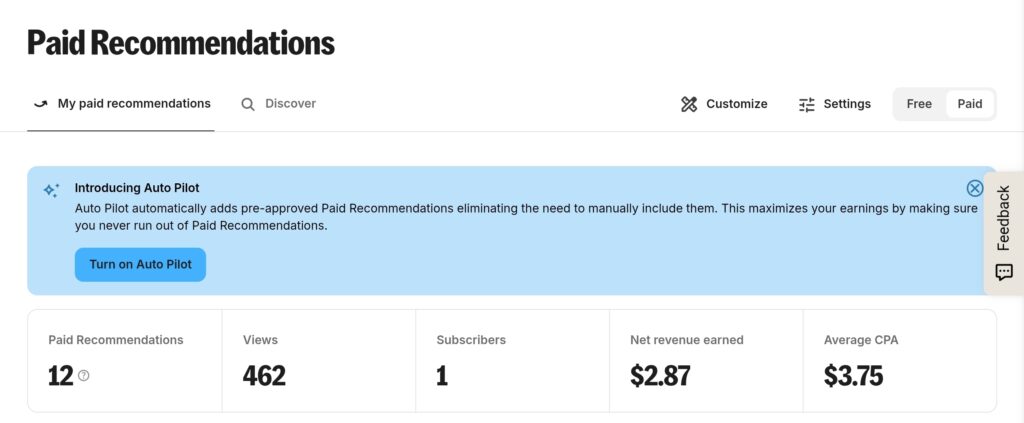
Data from kit went from this in the first months with auto pilot on:
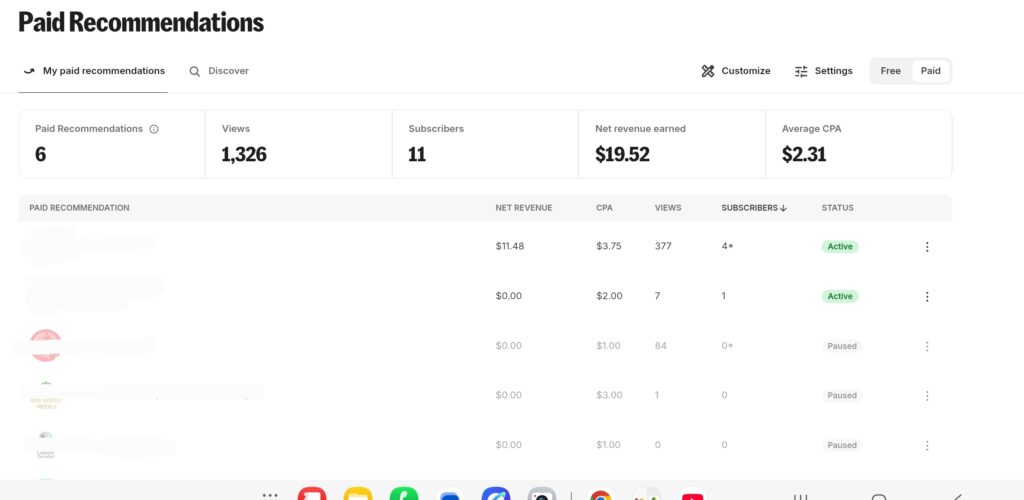
to this:
Data from SparkLoop:
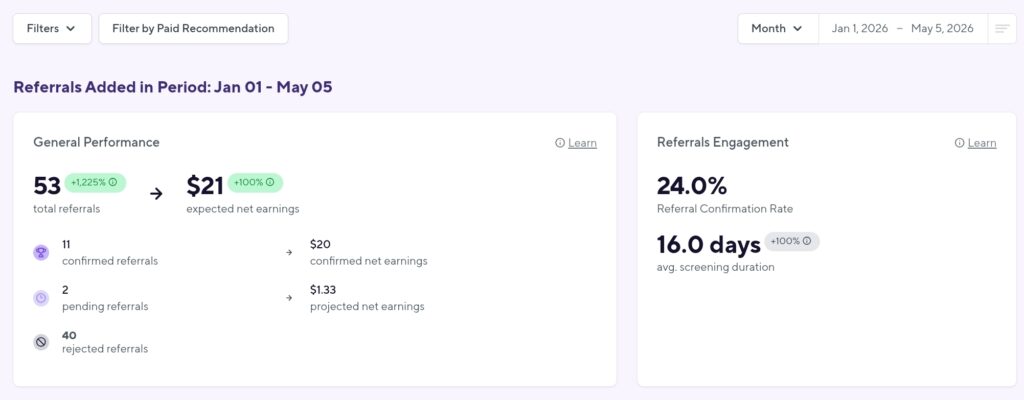
By late January, this small account had:
- 12 paid recommendations active
- 462 widget views in January to 1,300+ by May 5th.
- 1 confirmed subscriber, by May it already had 11.
- $2.87 in net revenue which became 21 USD by May 2026.
- $3.75 average CPA (the rate the sponsor pays per confirmed sub). CPA went down in Kit over time but earnings grew.
One subscriber. That’s it. But here’s the thing: this list earned its first dollar before the bigger account did, despite being roughly 5x smaller.
The CPA tells the story. $3.75 per confirmed sub is a healthy rate, and it suggests this is a niche where sponsors want quality more than scale. Crafts audiences tend to be loyal and niche-specific — exactly the kind of subscriber a smaller publication will pay a premium to acquire.
The Big List — High-Income Niche, 10,000+ Subscribers
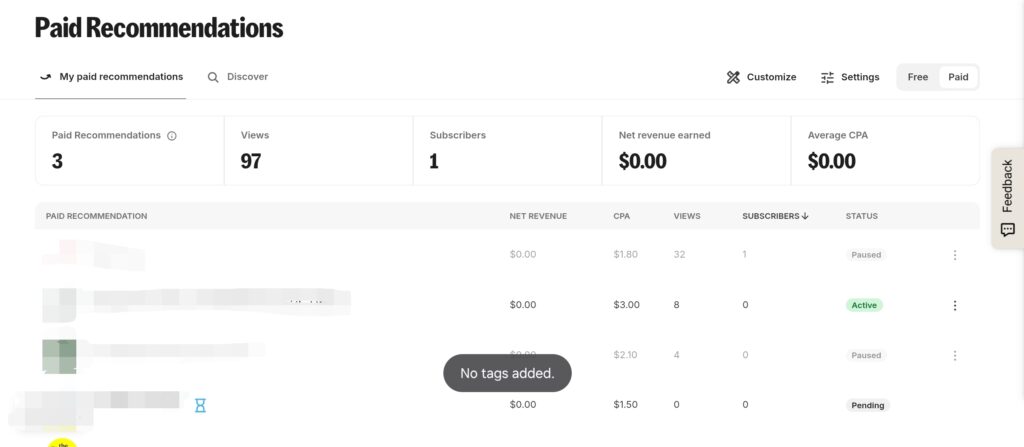
Some Paid Recommendations requests are pending approval since January! No income made.
What I’m Taking Away So Far
A few patterns:
- Niche specificity beats raw size, at least on conversion rate. The crafts list converted on its very first paid sub. The food list churns through more people but due to the forms setup it has no real opportunity to earn now.
- The rejection rate matters a lot. 40 of 53 referrals rejected on my craft list is a lot of effort for not much. SparkLoop’s own advice is to focus on weekly payouts rather than the count of confirmed or rejected referrals, and I half-agree. I do want to know my rejection rate so I understand list quality, but I won’t lose sleep over individual rejections.
- Imported subs are a hidden tax. The big list almost certainly has a higher ceiling than the small one, but only the slice that sees a native Kit form contributes to these numbers.
Tips to Squeeze More Out of It
A few things from SparkLoop’s own maximization guide that I’ve found genuinely useful:
- Customize the Upscribe widget copy. Default copy is fine. On-brand copy tailored to your audience converts noticeably better. Stacked Marketer’s widget is the example SparkLoop highlights and it’s worth studying.
- Use all 5 recommendation slots. Don’t run with 2 or 3 if you can run 5. Each slot is a chance to earn.
- Add in-email recommendations on top of the widget. Welcome sequences are obvious. Featured sections in your regular broadcasts work well too. SparkLoop’s Recommendations Hub is a single hosted page with multiple newsletters, perfect for a “newsletters I love” link in your footer or homepage.
- Manually add good-fit paid recs even with autopilot on. Autopilot starts with pre-approved publications. Manually adding relevant, audience-aligned newsletters broadens what you can earn from.
- Add a personal endorsement when you use Partner Links. A one-sentence “I read this every Sunday” goes much further than a bare link.
Important Limitations
- Newsletter Plan users can’t run Paid Recommendations at all. On Kit’s Newsletter Plan you can’t display Paid Recommendations and you’ll have one locked Smart slot you can’t customize without upgrading.
- Geographical restrictions apply. Some sponsors only want subscribers from specific countries and/or languages.
- Niche matters. There are WAY too much lists to recommend in finance, AI, and business industries and very few or none in a more lifestyle-friendly sectors. So if you have a relevant to popular niches email list, you will for sure earn more.
- Budgets run out. A high-paying sponsor can hit their monthly cap and stop showing, which is exactly what Auto Pilot is designed to handle.
- You need a Stripe account to receive payouts. Free to set up if you don’t have one.
What I Won’t Be Doing
A few things I’ve decided against, based on the test so far:
- No paid recs on re-engagement sequences. If I’m trying to reactivate a sleepy subscriber, the last thing I want is to send them toward someone else’s newsletter.
- Autopilot off. Too much downside risk on a broader audience and too many AI-related email recos I don’t need.
- I won’t measure success by referral count alone. Earnings per active subscriber per month is the real metric. If a list is making $5/month from 2,000 subs, that’s a quarter of a cent per subscriber per month. Unimpressive in isolation, but stacked with everything else (Kit Ads, products, Mediavine on the blog), it adds up.
Bottom Line
Paid Recommendations are a low-effort, low-ceiling income stream that genuinely pays a small check while you sleep, once it’s set up. Don’t quit your day job over it, but don’t ignore it either, especially if you’re already on Kit and not on the Newsletter Plan.
The bigger lesson from running both accounts in parallel: list size predicts ceiling, not floor. A small, specific list with 100% native form acquisition can outperform a big, broad list whose new subs come in through plugins and CSV imports. If you’re serious about this revenue stream, audit how your subscribers actually arrive, because that pipeline is doing more for your earnings than your subscriber count is.
If you want to try it for yourself:
- Sign up for Kit (free trial)
- Sign up for SparkLoop
I’ll keep updating this post with new numbers as the test runs.
Leave a Reply