
As a former Facebook Ads specialist who helped e-com businesses and online schools generate thousands of leads, I was really excited to join a small group of bloggers in food and craft niches testing Pinterest Ads offered within Pinterest mastermind community I am part of.
I didn’t know if ads can work for my small blog, but how will I know if I never try?
In the age of AI slop and lower and lower site earnings I keep looking for the next IT. So this time it was Pinterest Ads.
Masha has worked in digital marketing since 2016, as a CMO and as the owner of an ads agency. Today she runs Pinterest, content and email for bloggers and brands.
The Short Answer
My Pinterest Ads paid me back 21 to 27 cents for every dollar I spent. By Pinterest’s own benchmarks, those same campaigns performed well.
I spent years running Facebook Ads for ecommerce brands and online schools. When a small group of food and craft bloggers in my Pinterest mastermind decided to test Pinterest Ads, I joined in.
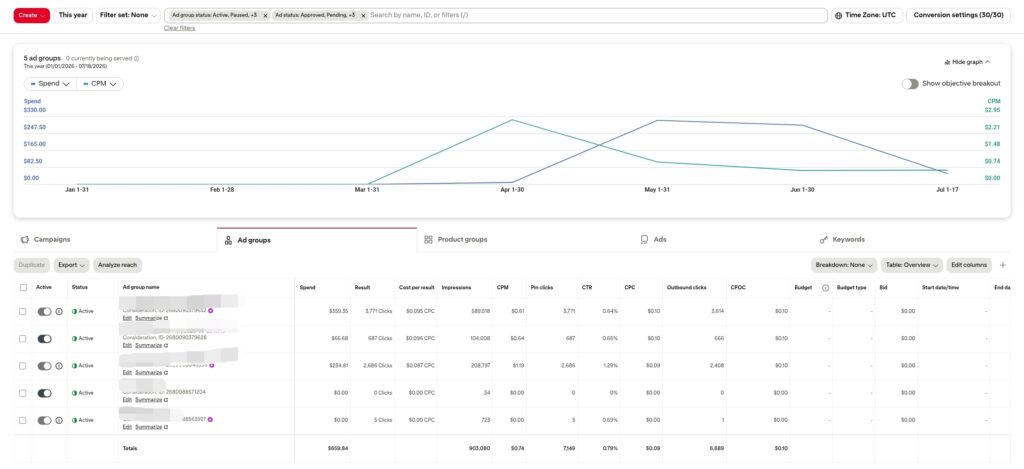
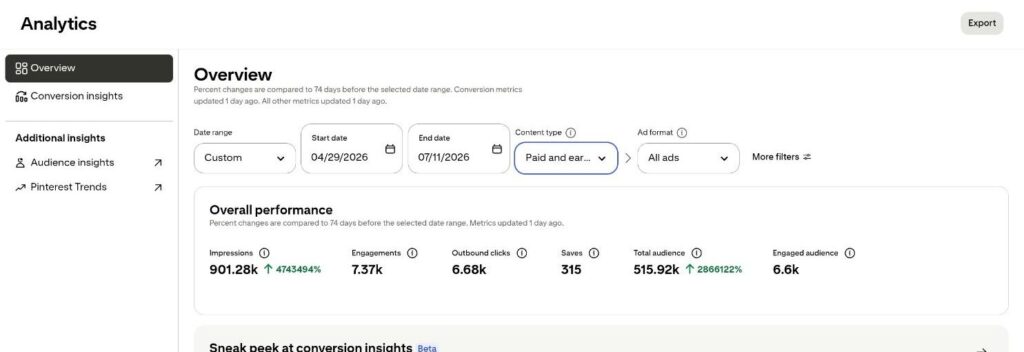
I ran three campaigns for 73 days on acrylicpaintingschool.com, my acrylic painting and crafts blog. I spent $659.84 and Pinterest reported 6,685 outbound clicks.
In this case study I share:
- What my clicks cost next to Pinterest’s own benchmarks
- How many of those clicks actually reached my site
- What the ads earned me in Mediavine revenue
- What happened to my organic Pinterest traffic before, during and after the ads
- What Pinterest’s ad team told me on a sales call
What the existing Pinterest Ads data actually measures
Almost every claim that Pinterest Ads boost organic reach traces back to two sources: old Pinterest beta data, or ecommerce brands.
In 2014, Pinterest reported that its beta advertisers saw about 30% extra earned media, plus another 5% in the month after their campaigns ended (MarTech).
Those numbers are freaking 12 years old! They counted saves, not clicks, and the testers were retail brands like Banana Republic and Lululemon (Digital Commerce 360).
The newer studies come from shops. Semaine Health ran a lift test and found Consideration ads alone drove an 11.5% incremental increase in sales (WorkMagic). MaryRuth Organics used marketing mix modeling to measure Pinterest’s halo on Amazon and other retailers (Pinterest Business).
Both studies measure product sales. Neither tells a blogger anything about organic pin distribution, outbound clicks or ad revenue on a craft or recipe or destination post.
Pinterest builds its ad tools for businesses that sell something.
Consideration campaigns aim for pin clicks or outbound clicks, and Pinterest requires Performance+ bidding if you optimize for outbound clicks. So you can’t cap what you pay per visitor.
Measuring the result is messy too. One advertiser reported 907 outbound clicks in Pinterest and only 11 sessions in GA4, even after Pinterest support confirmed the UTM setup.
I couldn’t find one case study that answered the question bloggers actually ask. If I pay for clicks, do they pay for themselves through ad revenue, email signups or organic growth?
So I tested it!
How I set up the test
I ran three Consideration campaigns back to back, at about $10 a day for the first two and $5 a day for the last. I DO NOT have big budgets nor big patience, so my numbers may not be ideal 🙂
| Campaign | Dates | Targeting | Content | Spend | Daily spend |
|---|---|---|---|---|---|
| 1 | Apr 30 – May 23 | Performance+ | 10 seasonal roundups | $234.81 | ~$9.78 |
| 2 | May 23 – Jun 28 | Performance+ | Single posts with a printable email signup | $359.35 | ~$9.71 |
| 3 | Jun 28 – Jul 11 | 24 keywords, one ad group | 15 pins in rotation | $65.68 | ~$4.69 |
I paused the roundup campaign after about three weeks. Organic traffic didn’t improve and nothing else looked promising.
For Campaign 2, I switched to individual posts with a printable freebie and an email signup form. If clicks wouldn’t pay through ad revenue, maybe they would through my email list – it was my theory!
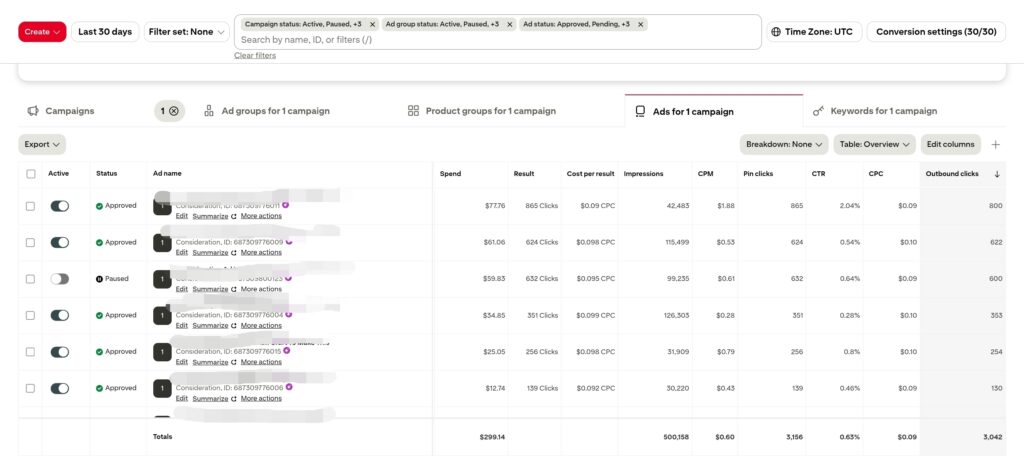
Most of the promoted pins were fresh, with no organic history. That matters later, when we look at what happened to organic traffic -__-
My site has no pop-ups that would “worsen” the user experience. I also didn’t install the Pinterest tag at that time, since nothing on a blog counts as a “conversion” in Pinterest’s sense, and even the Pinterest sales rep couldn’t tell me what I should be measuring.
Results: cheaper than Pinterest’s benchmark, every time
My clicks cost about one-sixth of Pinterest’s own benchmark ($0,60 CPC). Every campaign also landed on almost exactly the same price.
| Campaign | Impressions | CPM | Pin clicks | Outbound clicks | Outbound click rate | Cost per outbound click |
|---|---|---|---|---|---|---|
| 1. Roundups, Performance+ | 207,922 | $1.13 | 2,671 | 2,404 | 1.16% | $0.098 |
| 2. Email posts, Performance+ | 589,991 | $0.61 | 3,782 | 3,618 | 0.61% | $0.099 |
| 3. Keywords | 104,207 | $0.63 | 689 | 667 | 0.64% | $0.098 |
| Total | 902,120 | $0.73 | 7,142 | 6,689 | 0.74% | $0.099 |
Pinterest’s sales deck lists a $0.60 CPC benchmark and a 0.7% CTR benchmark for Consideration campaigns. I paid $0.092 per pin click, and my pin click rate came in at 0.79%.
So by Pinterest’s standards, these campaigns did well.
Roundups earned the best click rate but cost the most to show. Single posts showed cheaply but got clicked less often. Keywords landed in the same place as Performance+.
The price never really moved. Roundups or single posts, my keywords or Pinterest’s targeting, $10 a day or $5: each campaign cost between $0.098 and $0.099 per outbound click. So I guess the setup isn’t that impactful…
The 10+ bloggers in my mastermind group saw mainly the same thing. Most could not get below about 10 cents a click, which looks a lot like a price floor.
However, in Campaign 3 I used 24 keywords, one short of Pinterest’s recommended minimum of 25 per ad group (Pinterest Help). It also ran only 14 days at half the budget. It isn’t a full test of keyword targeting but best I could do.
Where the clicks went
Only 61% of the clicks Pinterest charged me for showed up as visits in Google Analytics. *Fabulous*
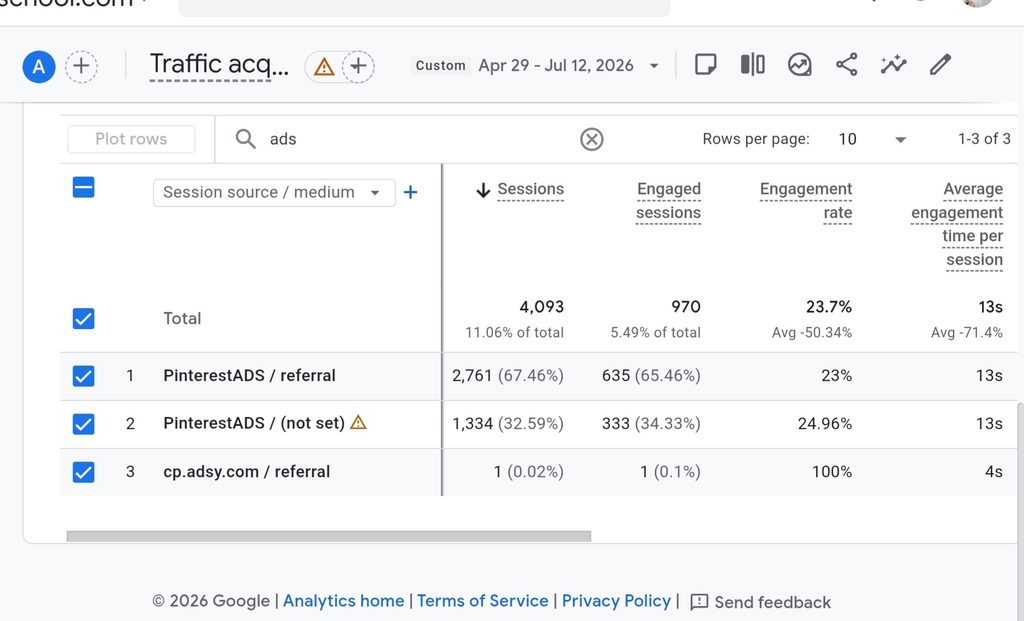
We all know GA is not perfect in reporting but whether the clicks were misattributed or simply never registered (which means it can be the case that I wasn’t even paid for them by Mediavine) … we will never know.
| Metric | Paid Pinterest traffic | My site average |
|---|---|---|
| Outbound clicks (Pinterest) | 6,685 | |
| Sessions (GA4) | 4,093 | |
| Engaged sessions | 970 | |
| Engagement rate | 23.7% | ~48% |
| Average engagement time | 13 seconds | ~45 seconds |
That puts the real cost at $0.16 per visit, and $0.68 per engaged visit.
Part of the gap is normal. Some people tap away before the page loads, and in-app browsers lose some tracking. But 39% is a lot of missing visitors.
Another sad observations is that the visitors who did arrive from Ads barely stayed. They spent 13 seconds on the page, while my average reader stays about 45 for this type of the posts and minutes for guides.
The money: $659.84 in, about $137 to $181 back
The ads earned back between $137 and $181 in Mediavine revenue. That’s a loss of roughly $480 to $520. Hardly can count as good ROI in my CMO past lol.
Mediavine doesn’t split paid and organic Pinterest traffic, so I estimated from two angles:
| Estimate | How I calculated it | Revenue | Back per $1 spent |
|---|---|---|---|
| Best case | 4,093 paid sessions × my $44.30 Pinterest session RPM | ~$181 | $0.27 |
| Realistic | 4,093 paid sessions × $33.54 RPM on the promoted posts | ~$137 | $0.21 |
The best case assumes paid visitors earned as much as my organic Pinterest readers. They didn’t: they stayed about 70% less time, so they saw fewer ads.
Here’s a real-world check. Six of the promoted posts earned $71.27 combined in ad revenue over the whole 75 days, from every traffic source.
Yes, my niche is not as high-earning as food or finance, so it is fair to assume that more profitable niches can perform better.
The break-even math
To break even on ads, each visit has to earn more than it cost. The formula is simple:
Break-even RPM = cost per session × 1,000
My cost per real session was $0.16.
So I needed a session RPM of about $161 to break even. My actual Pinterest session RPM was $44.30 and I can swear I have never had an RMP of 161 USD. I would not run ads for sure with such numbers!!
At Pinterest’s $0.60 benchmark CPC, the math gets worse, if it’s possible. Each real visit would cost about $1, and a blog would need a session RPM near $1,000 to break even.
What RPM would you need to break even?
Here’s the session RPM a blog needs just to cover the cost of paid Pinterest clicks.
| Cost per outbound click | Break-even session RPM if 61% of clicks land (my result) | Break-even session RPM if 85% of clicks land |
|---|---|---|
| $0.10 (my campaigns and my group’s floor) | $161 | $116 |
| $0.15 | $246 | $176 |
| $0.25 | $410 | $294 |
| $0.60 (Pinterest’s benchmark level) | $984 | $706 |
Compare these numbers to your own session RPM in Mediavine or Raptive, not your page RPM.
Leave a margin too. My paid visitors stayed 70% less time than my average reader, so they earned less than my site average.
If you run a large food blog, Q4 is the one window worth a look. RPMs climb before the holidays, and Pinterest users plan months ahead. If your Q4 session RPM clears the line in this table, a small, tightly targeted holiday test could pay for itself.
The email subscribers
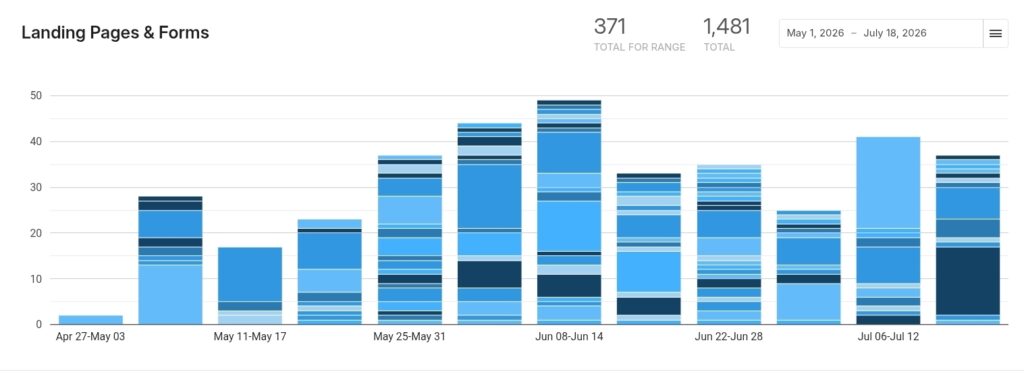
Campaign 2 (individual posts with email sign ups) added 177 net subscribers through my printable signup forms. If all of them came from the ads, that’s about $2.03 per subscriber.
The segment opens and clicks reasonably well but it has earned me $0 so far as I don’t sell any products. They did visit back my posts from emails I sent, but it is also possible that they Unsubscribe and I will not be able to convert them even to readers.
Did the ads lift my organic reach? No.
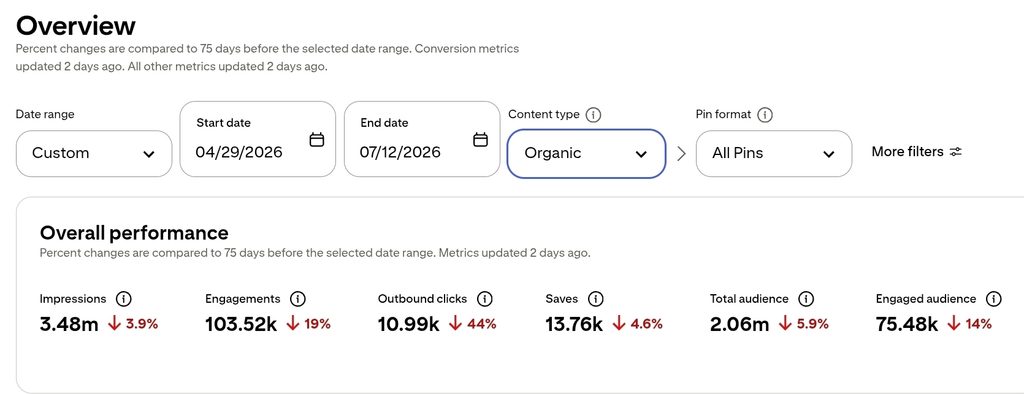
My organic outbound clicks fell by almost half during the ads, and they stayed at that level after I stopped.
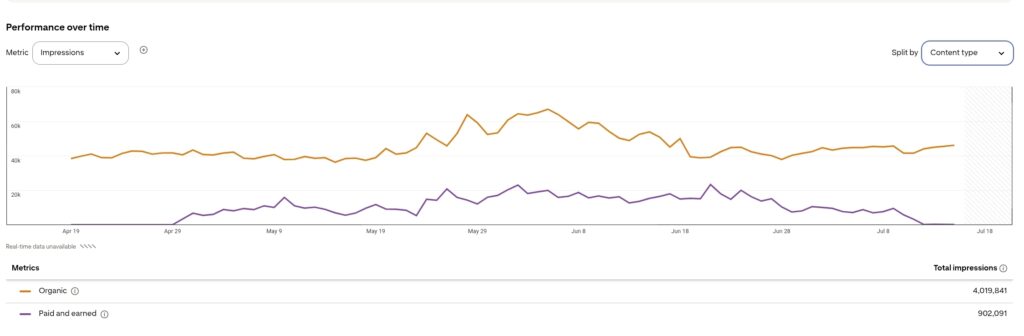
Fair note: The organic drop might not be caused by the ads. end of spring and summer are not the best for many niches in terms of earnings unless you are in food niche.
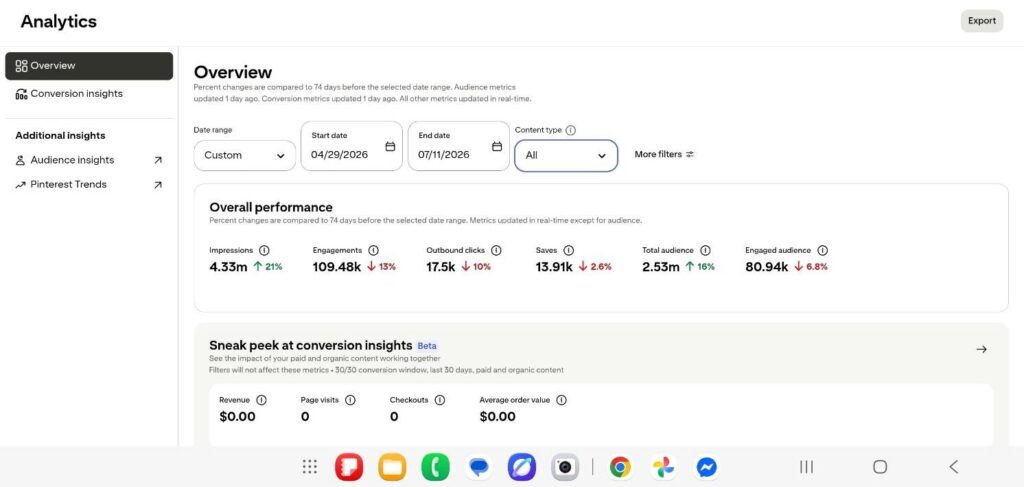
Pinterest’s dashboard mixes paid and organic numbers by default, so I filtered to organic only. The windows run different lengths, so I compared daily averages.
| Per day, organic | Feb 1 – Apr 29, 2026 (before ads) | Apr 29 – Jul 11, 2025 (last year, no ads) | Apr 29 – Jul 11, 2026 (during ads) | Jul 12 – Aug 31, 2026 (after ads) |
|---|---|---|---|---|
| Outbound clicks | 281 | 207 | 146 | 143 |
| Impressions | 48,523 | 52,838 | 46,388 | 40,000 |
| Saves | 192 | 306 | 184 | 159 |
| Engagements | 1,728 | 1,840 | 1,380 | 1,262 |
Seasonality doesn’t explain the drop. Pinterest only keeps my data back to April 9, 2025. But from April 9 to 28 last year, I averaged about 200 outbound clicks a day. Last summer held at 207.
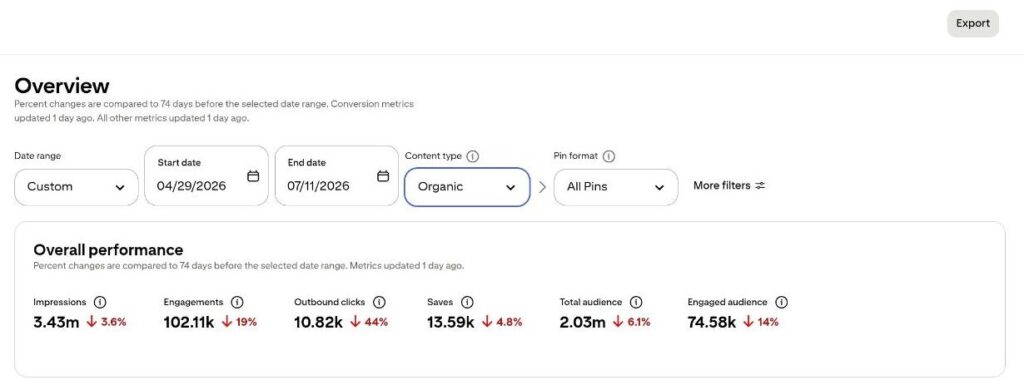
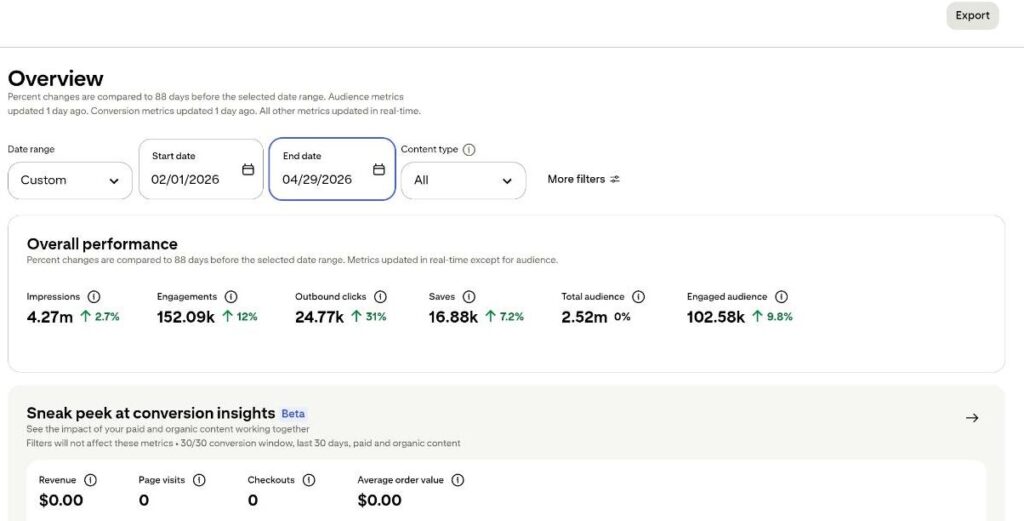
This year, organic clicks fell from 281 a day to 146 during the ads. Compared to the same dates last year, that’s 29% lower.
Stopping the ads changed nothing. Organic clicks went from 146 a day during the ads to 143 after. No crash or recovery needed as many fear. So don’t be afraid to stop ads if they don’t perform.
My organic impressions did climb from about 40,000 to nearly 70,000 a day in late May and early June. That’s the bump many bloggers experience. By mid-June impressions fell back to 40,000 while Campaign 2 still ran, and organic clicks did not bounce back.
Pinterest’s own playbook explains how ads should help organic. People who see your paid pins save them, and those saves start organic distribution.
Eh.. didn’t happen
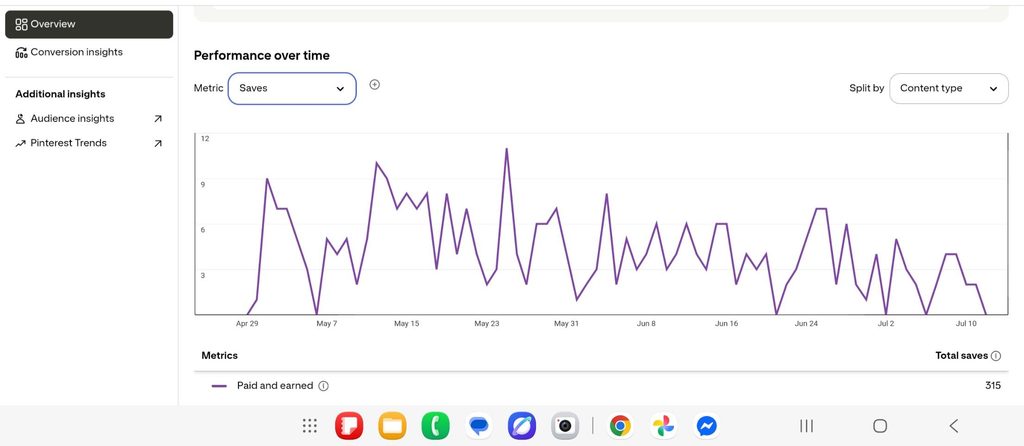
My paid pins earned 315 saves from 901,283 impressions. That’s a save rate of 0.035%. My organic pins earned saves at 0.40% over the same dates, about 11 times more often (13k+ saves).
My call with Pinterest
In June I had a sales call with Pinterest’s ads team.
It made one thing clear: Pinterest’s ad team doesn’t know how content sites earn money or doesn’t care.
The rep suggested a $30 daily budget. At that level, I’d get a personal account manager to monitor the strategy and advise on numbers. I declined.
When I asked why 10+ bloggers couldn’t get below about 10 cents a click, the rep couldn’t explain it.
What the sales deck shows
The rep followed up with a sales deck. Every goal in it is a commerce goal:
- The conversion stage measures purchases, add-to-cart and signups, judged by CPA or ROAS
- The projected metrics include “Sales Qualified Lead”
- The launch plan spends $500 across three campaigns and ends in a conversion campaign
- Step one of setup is installing the Pinterest tag, which retargeting and lookalike audiences depend on
Nothing in it measures what a blog earns from: pageviews, RPM or time on page.
The rep also sent Pinterest’s organic content playbook. The file dates from 2021.
Its pitch is that paid and organic work better together. It says the most successful partners mix promoted ads with organic content.
My data shows where that breaks for a blog. People saved my paid pins 11 times less often than my organic ones, so I am not sure how to take the “official” advice.
The call wasn’t a total loss. Two insights helped:
- Interests and keywords target different things. Interests come from what people engage with in their home feed. Keywords come from what they actually typed into search.
- Plan seasonal content early. Pinterest’s moments calendar still recommends pinning 8, ideally 10, weeks before a major holiday.
Limitations of my case study
This is one blog in one niche, so treat it as a strong data point, nothing more.
- One site. These results come from an acrylic painting and crafts blog. A food blog with a higher RPM would get more back per visit, though still far short of break-even.
- Shorter posts. Some promoted posts were shorter, with fewer ad slots per page. Long posts earn more per visit.
- A limited keyword test. Campaign 3 used 24 keywords for 14 days at half the budget.
- No Pinterest tag. I can’t see what Pinterest’s Conversion Insights would have tracked.
- Platform changes. I can’t rule out a Pinterest-wide drop in outbound clicks this year. That would explain part of the organic decline, but not a lack of lift from the ads.
My verdict
For a blog that earns from display ads, Pinterest Ads aren’t worth it.
Even campaigns that beat Pinterest’s benchmarks lost me about 75 cents on every dollar.
They also didn’t lift my organic reach, during the ads or after.
Pinterest Ads can make sense if you have one of these:
- A paid product at the end of your funnel. Freebies only pay off if your email list sells something.
- A digital product to promote directly. Send ads straight to the sales page or to the post that converts best.
- A very high RPM. You’d need a session RPM of about $161 at my click costs just to break even.
If you just want more readers, put that $660 into fresh organic pins instead.
Want help deciding?
I ran Facebook Ads for ecommerce brands and online schools before I ever touched a blog. Ads still work well when there’s a product at the end of the click.
If you sell physical or digital products, I can set up or run your Pinterest Ads. I offer two options:
- One-time setup, $125. I install your Pinterest tag, set up UTM tracking, research your keywords and build your first campaign. Then I hand it over with notes.
- Monthly management, $500/month. I run and optimize your campaigns, test new pins and send you a monthly report.
Get help with your Pinterest Ads
Sources
- Pinterest Help: Campaign objectives
- Pinterest Help: Keyword targeting
- Pinterest Business: 2026 moments planning guide
- Pinterest Business: MaryRuth Organics success story
- WorkMagic: Semaine Health Pinterest lift test
- MarTech: Promoted Pins early results (2014)
- Digital Commerce 360: Promoted Pins rollout (2014)
- Pinterest Business Community: outbound clicks vs. GA4
- Pinterest sales deck and Organic Content Playbook (2021), shared by a Pinterest partner manager
- My own data: Pinterest Ads Manager, Pinterest Analytics, GA4, Mediavine and Kit, Apr 2025 – Aug 2026
Leave a Reply